Three13 · Music & Culture Feature
Carl CraigArchitect of theSecond Wave
How a working-class kid from Cooley High turned Detroit techno into a universal language — through records, a label, a festival, and an art installation that lives in a museum.
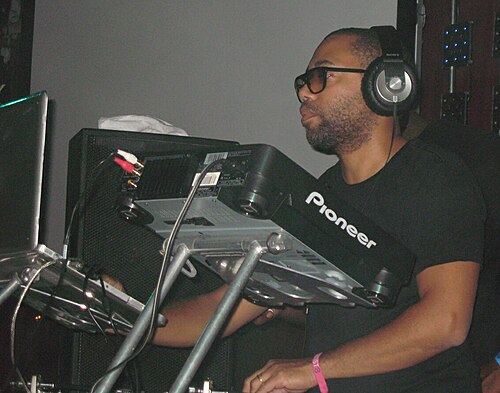
Detroit techno didn't stop with the Belleville Three. It kept moving, kept mutating, kept finding new voices — and no voice has carried it further than Carl Craig. Born in 1969 on Detroit's west side, Craig grew up in a working-class household where music was supreme — his father delivered mail, his mother taught school, and the record collection never stopped spinning. By the time he was a teenager, he was captivated equally by the cold futurism of Kraftwerk and Depeche Mode and by the local revolution happening in his own backyard: Juan Atkins, Derrick May, and Kevin Saunderson inventing a genre from spare parts and imagination.
The Protégé Builds a Platform
Craig's introduction to electronic music came through Derrick May's radio program Street Beat. After experimenting on basic equipment, he was introduced to May and became his protégé, folded into the Rhythim Is Rhythim project and taken on a European tour. His early releases — Breakdown and Evolution, issued under the aliases Psyche and BFC on May's Transmat and Fragile labels — gained cult status in underground scenes on both sides of the Atlantic.
Like many of Detroit's early techno entrepreneurs, Craig didn't wait for someone else to build the platform. In 1991 he created Planet E Communications, a label that became far more than a vanity imprint. Over the decades it has released records by Kevin Saunderson, Moodymann, Kenny arkin, and Stacey Pullen — a community of artists carrying Detroit's legacy in very different directions. Planet E was a mission statement: techno could expand into house, jazz, funk, and left-field electronics without ever leaving the city's DNA.
When Techno Got Jazz Bones
If you want proof that Craig never saw techno as a closed system, look at Innerzone Orchestra, founded in 1992. The project blended electronic music with live jazz musicianship and produced one of his most celebrated tracks, Bug in the Bassbin — a record that reminds you Detroit isn't only about speed and pressure, but about depth, swing, and musical knowledge. The 1999 album Programmed remains a landmark of the genre, a fusion that critics still cite as a high-water mark for what dance music could aspire to.
His studio albums — from Landcruising (1995) to More Songs About Food and Revolutionary Art (1997), which Pitchfork placed among the 50 best IDM albums of all time — show a producer who treats the album as a canvas, not a playlist.
The Festival, the Lawsuit, the Return
In 2000 and 2001, Craig served as co-creator and artistic director of the Detroit Electronic Music Festival — helping define what a modern city-center electronic festival could be. His dismissal by festival organizers sparked substantial controversy within the Detroit techno community and a high-profile campaign in his favor; he filed a breach-of-contract lawsuit against producer Pop Culture Media in 2001. He returned as artistic director for the 2010 edition, a homecoming that reaffirmed his centrality to the city's musical identity.
"Detroit's sound didn't come from nowhere. It grew out of a city built on music that already knew how to hit emotionally and physically — Motown, soul, jazz, funk, gospel." — Carl Craig
From the Dancefloor to the Museum
In 2020, Craig made his first major foray into the art world with Party/After-Party, an immersive sound-and-light installation that premiered at Dia:Beacon in New York before moving to The Geffen Contemporary at MOCA in Los Angeles in 2023. The culmination of a five-year engagement with Dia:Beacon, the work fuses the legacies of Detroit techno with minimalist sound art — guiding viewers through 30-minute immersive soundscapes, never surpassing 100 BPM, from party to after-party to dawn, experienced from the perspective of the DJ.
In 2021, he collaborated with Daniel Lee, then creative director of Bottega Veneta, on the Salon 03 show in Detroit — creating Runway, a multi-floor experience at the Michigan Building Theater. And in 2024, the documentary Desire, the Carl Craig Story, directed by Jean-Cosme Delaloye, premiered at the Tribeca Film Festival, tracing his life from high school through global influence with contributions from Laurent Garnier, Moodymann, and Gilles Peterson.
A Career in Motion
1989
First releases under aliases Psyche and BFC on Derrick May's Transmat and Fragile labels, gaining cult status in the US and Europe.
1991
Founds Planet E Communications, a label that would become a cornerstone of Detroit's electronic ecosystem and a platform for artists like Moodymann, Kenny Larkin, and Kevin Saunderson.
1995
Releases debut studio album Landcruising on Blanco y Negro Records, establishing his singular voice beyond the dancefloor.
1999
Releases Programmed under the Innerzone Orchestra moniker, fusing techno with live jazz instrumentation — a landmark of the genre.
2000
Co-creates and serves as artistic director of the Detroit Electronic Music Festival, helping define the city's modern festival culture.
2008
Nominated for a Grammy Award for Best Remixed Recording for his remix of Junior Boys' 'Like a Child.'
2020
Premieres Party/After-Party, an immersive sound-and-light installation at Dia:Beacon — his first major foray into the contemporary art world.
2024
Subject of the documentary Desire, the Carl Craig Story, premiering at the Tribeca Film Festival.
Recognition
- ◆2008 Grammy Award Nominee — Best Remixed Recording, Non-Classical
- ◆Co-founder & artistic director, Detroit Electronic Music Festival (2000–2001, 2010)
- ◆Subject of 2024 documentary Desire, the Carl Craig Story (Tribeca premiere)
- ◆Party/After-Party acquired into Dia:Beacon permanent collection
Learn More
Frequently Asked
Who is Carl Craig?+
Carl Craig is an American electronic music producer, DJ, and founder of the label Planet E Communications. Born in Detroit in 1969, he is a leading figure of the second wave of Detroit techno and has shaped the genre since the late 1980s through recordings under his own name and aliases like Psyche, BFC, 69, Paperclip People, and Innerzone Orchestra.
What is Planet E Communications?+
Planet E Communications is the record label Carl Craig founded in 1991. It has released records by Craig alongside other Detroit artists including Kevin Saunderson, Moodymann, and Kenny Larkin, and is regarded as one of the most influential independent electronic labels of its era.
What is Carl Craig's connection to the Detroit Electronic Music Festival?+
Craig co-created and served as artistic director of the Detroit Electronic Music Festival (now Movement) in 2000 and 2001, and returned as artistic director in 2010. His involvement helped establish Detroit's modern festival culture on a global stage.
What is Party/After-Party?+
Party/After-Party is an immersive sound-and-light installation Carl Craig created in 2020, premiering at Dia:Beacon before moving to MOCA in Los Angeles. It fuses the legacy of Detroit techno with minimalist sound art and became part of Dia:Beacon's permanent collection.
About This Feature
This Three13 feature draws on verified public sources including Carl Craig's official site, Wikipedia, the Detroit Historical Society, MOCA, and Gray Area Magazine. All factual claims — label founding dates, Grammy nomination, festival roles, and the Party/After-Party installation — are drawn from the cited sources above. The portrait is sourced from Wikimedia Commons and used editorially.