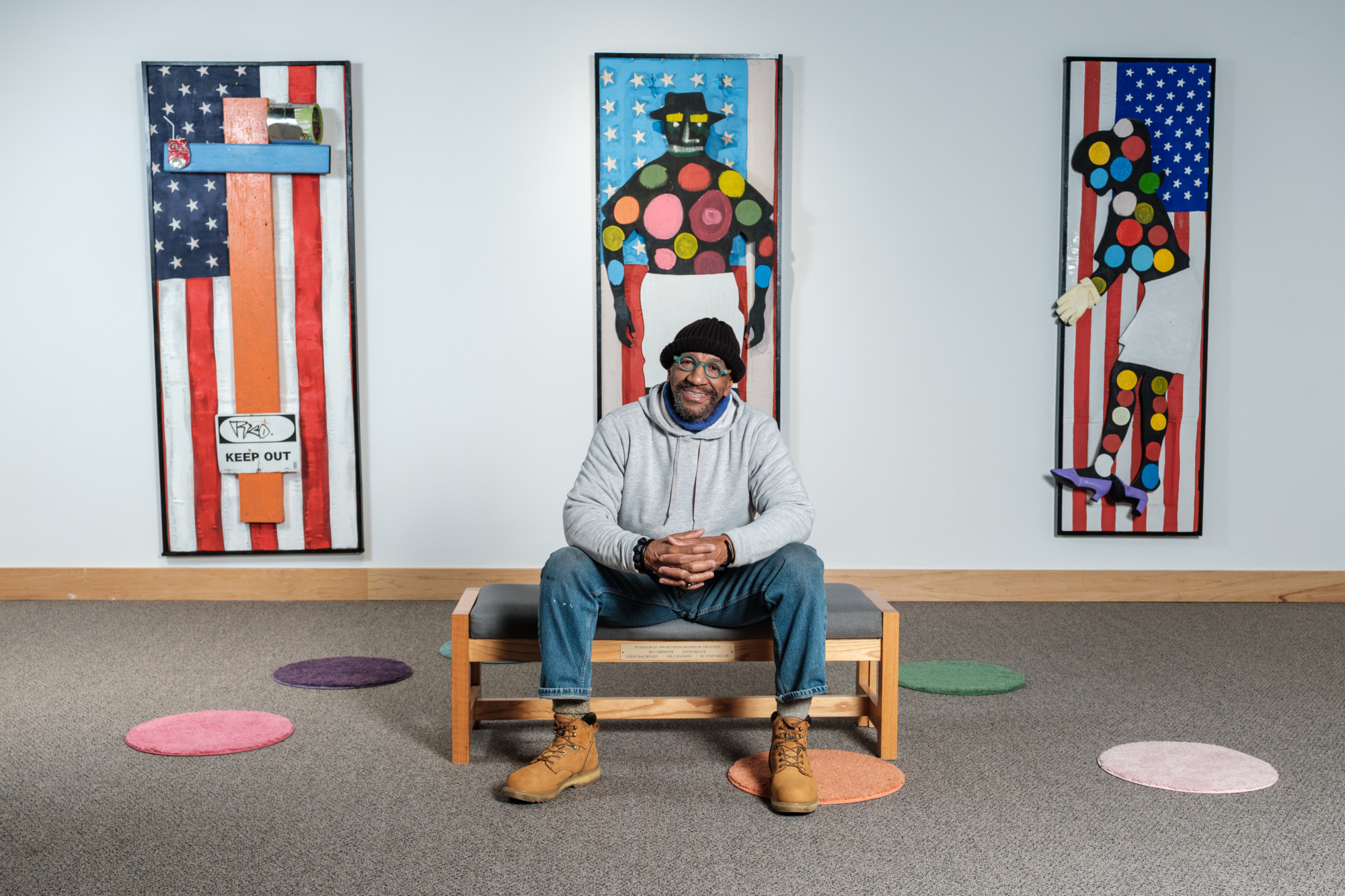
A Paintbrush from Grandpa Mackey
Tyree Guyton was born in 1955 on Heidelberg Street — the very street that would become his life's work. The third of ten children, he was raised in a family that had called the block home since 1947. At age 9, his grandfather Sam Mackey, a commercial sign painter, handed him a paintbrush. "It was like magic," Guyton recalls. "It was like bells and whistles went off in my head. My hand was burning. I knew then that I was put here to be an artist."
But the path was not direct. Guyton dropped out of high school in 1972 to enlist in the U.S. Army. He returned to Detroit, earned his GED, and spent the late 1970s and early '80s on the assembly lines at Ford and Chrysler as a UAW member. He became a Detroit firefighter. Only when the calling became "too loud to ignore" did he enroll at the Center for Creative Studies, studying under Detroit legend Charles McGee. He dropped out after being told he "didn't fit in." It was the best thing that ever happened to him.
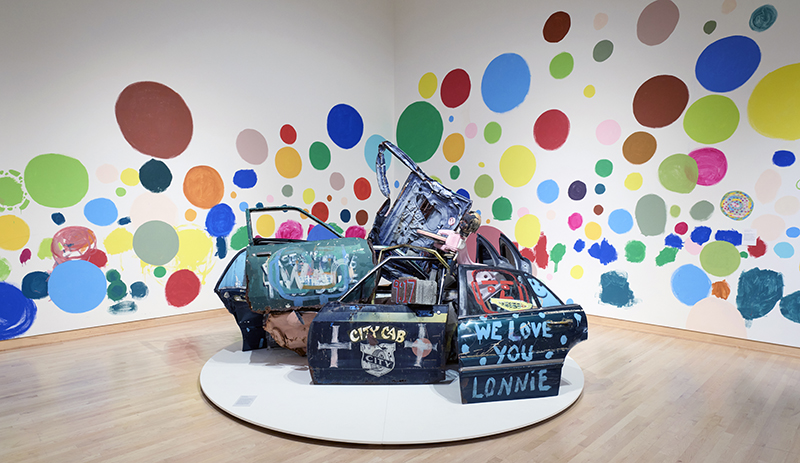
"Auto World" (1998–2025), mixed media installation. Via The Kresge Foundation.
The Street Was Talking to Me
On a sunny day in April 1986, Guyton looked out onto his block — then ravaged by redlining, the aftermath of the 1967 uprising, and decades of disinvestment. "The street was talking to me," he says, "telling me what it wanted to become. It was asking for beauty."
He began picking up trash with his grandfather. Then, as Mackey had taught him, he picked up a paintbrush and started splattering bright polka dots onto abandoned properties. Soon came dolls, stuffed animals, clocks, shoes, televisions, and car hoods — all painted, nailed to trees and houses, arranged into a visual wonderland that stretched across several blocks. He called it the Heidelberg Project.
Surviving Demolition & Fire
The City of Detroit demolished Guyton's installations twice. Between 2013 and 2015, a series of unsolved arson fires destroyed 12 of his artistic houses. The project survived six mayoral administrations, two demolitions, and 13 fires. "This was always a message of love from me to the city," Guyton says — "a beautiful rebuttal" to Detroit's battle against blight.
The 2026 Kresge Eminent Artist
In January 2026, Guyton was named the 18th Kresge Eminent Artist — Detroit's most prestigious cultural honor, carrying a $100,000 prize, a short film, and a monograph. "Surreal," is how Guyton describes the moment. "I felt like Moses. All I heard clearly was, 'eminent' and 'you've been chosen.'"
The award coincides with the Heidelberg Project's 40th anniversary and its reimagining as "Heidelberg 3.0" — a transition that will showcase a new generation of Detroit artists in the spaces along Heidelberg and Elba streets. His largest-ever solo exhibition, Heidelbergology: Is it Art Now?, is currently on view at the John Michael Kohler Arts Center in Sheboygan, Wisconsin.
Career Timeline
Born on Heidelberg Street in Detroit's McDougall-Hunt neighborhood. Grandfather Sam Mackey, a commercial sign painter, hands him a paintbrush at age 9 — 'It was like magic.'
Drops out of high school and enlists in the U.S. Army. Returns to Detroit a year later, works the assembly line at Ford and Chrysler as a UAW member.
Enrolls at the Center for Creative Studies (now CCS) studying industrial design. Studies under Detroit legend Charles McGee. Drops out after being told he 'didn't fit in.'
Launches the Heidelberg Project with grandfather Sam Mackey — transforming abandoned houses and vacant lots on Heidelberg Street into a massive outdoor art environment.
Receives the Spirit of Detroit Award. The City of Detroit had previously ordered demolition of his installations, but international attention forces a reversal.
Subject of the Emmy Award-winning HBO documentary 'Come Unto Me: The Faces of Tyree Guyton.'
Awarded honorary Doctor of Fine Arts from the College for Creative Studies. Earns inaugural Kresge Artist Fellowship in the visual arts.
Major 30-year retrospective at the Museum of Contemporary Art Detroit (MOCAD) — 'Tyree Guyton: 30 Years in the Hood.'
Named the 18th Kresge Eminent Artist, receiving a $100,000 prize, a short film, and a monograph. The award coincides with the Heidelberg Project's 40th anniversary.
Frequently Asked Questions
Who is Tyree Guyton?
Tyree Guyton (b. 1955) is a Detroit-born Neo-Expressionist painter and urban environmental artist best known as the creator of the Heidelberg Project — one of the world's most influential outdoor art environments, located on Heidelberg Street in Detroit's McDougall-Hunt neighborhood.
What is the Heidelberg Project?
Launched in 1986, the Heidelberg Project is an open-air art environment where Guyton transformed abandoned houses, vacant lots, and city streets into massive installations using discarded objects — shoes, dolls, clocks, car hoods, and polka dots. It has survived two city demolitions and 13 arson fires.
What awards has Tyree Guyton won?
Guyton's honors include the 2026 Kresge Eminent Artist Award ($100,000), the 2009 Kresge Artist Fellowship, the Spirit of Detroit Award (1989), Michiganian of the Year (1991), the City of Detroit Award for Artistic Excellence (2007), an honorary Doctorate of Fine Arts from CCS (2009), and an Honorary Doctorate of Humane Letters from the Ecumenical Theological Seminary (2016).
Where can you see Tyree Guyton's artwork?
The Heidelberg Project is viewable outdoors on Heidelberg Street in Detroit. His studio work is held in the permanent collections of the Detroit Institute of Arts, the Studio Museum in Harlem, the Centre Pompidou in Paris, the University of Michigan Museum of Art, and the Charles H. Wright Museum of African American History.